


PAGE CONTENTS
Introduction
As businesses continue their return to full-scale operations post-lockdown, they face the reality that much has changed in the intervening period. Whether working from home or remotely at some other location, through to greater reliance on online resources, including video conferencing and collaborative working applications, the business landscape has shifted significantly.
What PwC’s Remote Work Survey found
Almost daily, another corporate giant announces that they are giving employees considerable freedom over when and where they ‘attend’ work in future. At the height of lockdown, PwC’s Remote Work Survey found that 69% of financial service companies expect almost two-thirds of their workforce to be working from home once a week in future. In that same survey, 75% of employees, surveyed, indicated that they believed that they had demonstrated similar, or greater, levels of productivity while working remotely and flexibly. That said, PWC concluded their survey by warning that while productivity levels had remained high, collaboration, coaching and communication standards would need careful managing if this model continued post-lockdown.
Small Medium Enterprises (SMEs)
While this may be true, and the evidence is irrefutable, in sectors where the major players have the capacity to incorporate flexibility across a workforce that is, by design, likely to be driven by personal financial gain through the achievement of targets, this doesn’t apply to all employers. According to the Federation of Self-Employed & Small Businesses (FSB), there were approximately six million Small, Medium Enterprises (SMEs) across the UK in 2020,
What the Federation of Self-Employed & Small Businesses (FSB) had to say
FSB statistics, gained through the Department of Business Innovation and Skills, also point to the fact that SMEs account for three-fifths of employment (61% of the total) and around half of the turnover (£2.3 trillion or 52%) in the UK private sector. With a hefty chunk of these people employed in customer-facing roles including in face-to-face retail services, the possibility of remote and flexible working is unrealistic for many.
That said, a fair number of those employed in SMEs, across the UK, fall into the category of support staff who, with the right infrastructure, could, realistically, work remotely and flexibly, most probably from home. So, would the results of PWC’s survey ring true in these cases?
Flexible working patterns
For well over a year now, a great many people, in SMEs here in the UK, have worked continuously from their homes. Throughout this time, evidence points to the fact that productivity remains high, despite the dispersed nature of the work undertaken by this, sizable, portion of the workforce. However positive productivity, on the face of it, belies a number of other areas that cannot be measured accurately in this model. For example, calls between staff and prospective clients cannot be monitored from home or mobile phones, in the same way that interactions using company-enabled landlines could be. Consequently, auditing these interactions, to guarantee quality, accuracy and consistency is very difficult. In this case, senior managers are unable to make informed judgements on missed sales opportunities and other vital metrics that could well necessitate continuation training on the part of the employees. Likewise, accepting payments using insecure home telephone numbers, without VPN access, makes it more difficult to secure business at the point of sale as many customers may be reluctant to pay remotely without the peace of mind offered through the use of VPN facilities. I accept that these impediments could be overcome with additional resources, but contend that many businesses could not afford to make these adjustments to facilitate hybrid working practices. So how do we measure productivity for a sizable portion of the UK workforce who now see working from home as the new ‘normal’?
Traditional methods of measuring productivity
While working in a manufacturing environment, productivity, for us, was measured very scientifically:
Productivity = Efficiency x Utilisation
In this scenario, determining productivity is a straightforward task: there is a finite amount of resources available (personnel and equipment), and each task can be measured against the optimal time to complete that task under ideal conditions. Therefore, in a workshop with five technicians working an eight-hour shift, there are a total of forty hours of work available (excluding breaks). In this case, each worker should be capable of completing four, two-hour jobs during that shift in order to be 100% productive. Variations in output affect productivity and deductions can be made, quite easily, to determine why productivity might be less than optimal: lack of available equipment, additional training requirements, sickness absence and poor workshop loading to name but four variables.
But understanding the productivity of workers operating remotely, most likely from home, is considerably more difficult to achieve using the traditional methods as described above. In these cases, traditional methods are less effective given the variable nature of the working environment which may expand or contract to suit the worker’s unique circumstances. After all, isn’t that the attraction of hybrid working post-lockdown?
Cultural Intelligence: a new metric to measure productivity?
I contend that cultural intelligence may offer a helpful metric to measure productivity in cases where traditional methods are less effective in the post-lockdown era. Cultural Intelligence is not another trendy catchphrase either. It is a way of looking at the key components of performance that help to create harmony and improve communication; vital characteristics in a disparate and diverse workforce operating flexibly across dispersed geographical locations. Definitions vary but I favour Cultural Intelligence as a combination of Knowledge, Behaviour and Mindfulness whereby peak performance is achieved when these three elements are in equilibrium. Too much emphasis on one will come at the detriment of the other two and performance will not be peak.
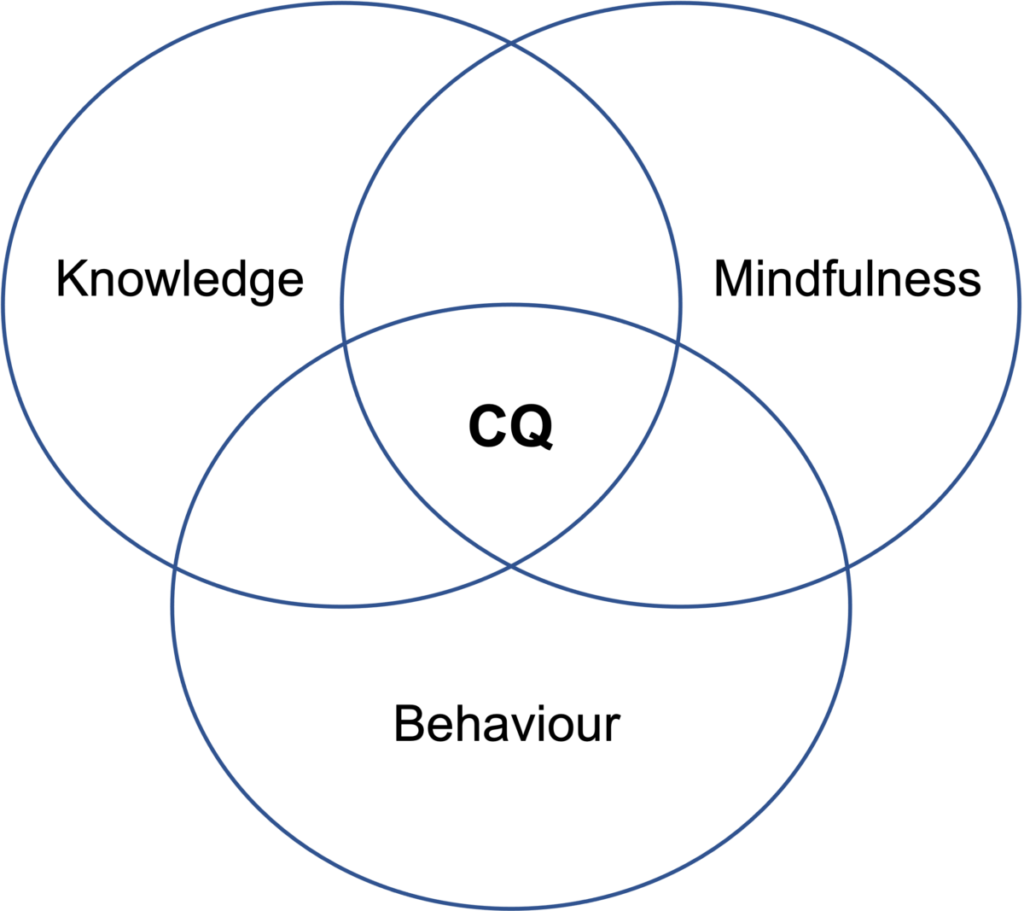
The elements of Cultural Intelligence
Ensuring that employees possess the correct knowledge to influence their behaviour in a way that impacts their willingness to accept and learn from others and not to judge them should increase empathy, tolerance, improve cooperation and build collaboration. This being done, productivity might be better measured using the following equation where Cultural Intelligence represents the all-important, coefficient:
Productivity = Cultural Intelligence(Efficiency x Utilisation)
Summary
I don’t contend that this will be achieved easily but I do believe, strongly, that productivity, in the hybrid working environment that has emerged post-lockdown, will be greatest in those companies who develop the cultural intelligence of their employees. Building knowledge, so that people, working from home, can act in support of the bigger agenda/picture speaks for itself as does engendering behaviour that encourages cooperation and collaboration to build consensus decision-making – including at a distance. Inculcating a mindful ethos in those operating in isolation may well lead to employees feeling valued for reasons other than simply achieving targets and receiving financial bonuses and as such they are likely to be more inclined to increase their productivity as a consequence. As the business landscape continues to evolve, post-COVID, investing in people’s ability to increase their awareness of the importance of Cultural Intelligence may well provide the winning edge for companies serious about hybrid working arrangements for their employees; only time will tell.